For better or worse (ok, probably worse

     |
Similar Articles: iOS 7 Theresa Vail freedom tower cote de pablo Garrett Clayton
For better or worse (ok, probably worse
| |
James Franco has big plans, always.
James Franco has big plans, always.
What is James Franco doing?
People started asking this question, in earnest, somewhere around the time he went on General Hospital in 2009. Up until then, he'd been a young actor whose path was relatively normal: he was on Freaks & Geeks, and in Never Been Kissed, and he played James Dean on cable. He was in the Sam Raimi Spider-Man movies, and then into Apatow country. Occasional forays into super-artsy stuff like films that showed in museums? No big deal. Nothing you wouldn't see from, say, Ethan Hawke or somebody like that. Swerves between, say, Pineapple Express and Milk, but that happens. Mork wound up in Good Morning, Vietnam, after all.
But then: General Hospital.
Appearances in mainstream stoner comedies are one thing, when it comes to changing up the highness of your brow and toying with the expectations people have of what you would and wouldn't do. But ... a soap? A real, straight-up soap? The same one Luke and Laura were on? Even knowing that he called the appearance a form of performance art, it continued to raise the question...
What is James Franco doing?
Right now, he's releasing his first alleged novel, Actors Anonymous, but we'll get back to that.
It's not like he needs another line of work. He has a band. He writes short stories. He hosted the Oscars. He was roasted on Comedy Central. He's taken many, many classes — and taught some, too. He makes offbeat art and appears in other people's offbeat art. He's played a hot guy on single-woman network sitcoms (both Tina Fey's and Mindy Kaling's).
At the time of a 2010 profile in New York Magazine, the question Franco predicted would be asked about him — and the writer told him was already being asked — was whether he was spreading himself too thin. But in fact, by doing so much, Franco may have achieved something that's almost impossible: he has no meaningful image other than as himself. There is nothing James Franco could do at this point that would move the needle.
What could he do that would seem out of place? What could he do that you really wouldn't expect? He wouldn't really surprise people if he won an Academy Award. He wouldn't really surprise people if he decided to take a one-day role in a Virgin Airlines video demonstrating seatbelts. He could show up in oil paintings, on a sitcom, as a Jeopardy! contestant, as the announced star of So Fast & Extra Furious 8, or in hard-core pornography, and nobody would really think it was anything other than a further example of Well, That's James Franco For You.
"I might be surprised if somebody else did that, but I can sort of believe it, coming from James Franco," is what a lot of us would say about literally anything he did with his career. Aside from something nefarious, even in his personal life, what could he really do now that would require a comeback, or a rehabilitation tour, or a second chance, or an audit of how audiences feel about him?
At times, he's seemed like the kind of guy who's obsessed with pretending he only touches the avant-garde — a self-styled intellectual who disdains everything that's not from art museums. But he's also perfectly happy to do Rise Of The Planet Of The Apes and Oz The Great And Powerful, two huge moneymaking films that have little connection to short films that wind up in museums. This year, he did This Is The End, a proudly stupid gross-out apocalypse comedy in which he and his friends play themselves.
Blockbusters, both self-consciously respectable and not so much? Fine. Obscurity? Fine. School? Fine. Art? Fine. Poetry? Fine.
And now he's published that "novel," Actors Anonymous. It's not really a novel; it's really a collection of ... stuff. Loosely — like, "XXXL shirt on XXXS body" loosely — based on the 12 steps of addiction treatment programs, it consists of short stories, snippets of scripts, and what it's hard not to envision as Things James Franco Wrote Down On The Back Of A Receipt One Time About Acting And Being Famous.
Among these snippets, there are flashes of insight — like, "I performed for money, and I performed for free. It's better to perform for money if you hate the director; it's better to perform for free if you love him." But there are also things nobody would pay money to read under normal circumstances — like, "There are some people that are very serious about their acting. But the ones that are too serious are boring and usually end up strangling their own performances." That would probably not make the cut if he said it in an interview; it's not really book material.
The fiction sections are stories about actors, but other themes tie them together: mostly, they are about young men driven nearly mad by some combination of generalized rage and a specific desire to have sex with, and sometimes to dominate and possess, women. They're far too inconsistent to be really satisfying, but they simmer with a sometimes intriguing frustration. Franco loves to intersperse signs that certain stories are autobiographical and that he's appearing in the book as "James Franco" or "The Actor," but there are also tweaked details that are meant to hold the reader at a slight distance and retain some sense of disorientation with regard to truth and fiction.
In other words, it's the James-Franco-iest book he could have written, because there's nothing to wrap yourself around. It's not very good, but it's not unambitious, and it's not lazy. It's about him but it's not, it's revealing but it's not, and in the end, it's interesting but it's not.
It's impossible for a celebrity to have an image that's a true blank canvas; we are far too voracious for that. But Franco has perhaps achieved the next best thing: a canvas onto which he's spilled so much paint in so many patterns that it ceases to look like anything, and anything you could add to it would look like it belonged there. And, of course, if you stare at it long enough, you can see patterns emerge and then recede — a poseur, a poet, something jarringly authentic, something painfully manufactured. Even, if you squint, the Last Honest Man In Hollywood, who puts out a book that demonstrates that like a lot of us, he has a certain number of sharp thoughts and an awful lot of mundane ones.
Lots of actors go high-low — the Steven Soderbergh "one for them, one for me" thing. But this is different; Franco has achieved a lack of definition that's unthinkable for a guy like George Clooney, no matter what combination of art-house movies and blockbusters he might make.
There was a lot of talk after Franco's Comedy Central roast about the number of jokes that focused on the idea that he's gay. If nothing else, you'd expect the people who were there to roast him, like Seth Rogen and Nick Kroll and Andy Samberg, to expect a little more from themselves than gay-panic har-har-ing like it's 1998. Even if they didn't worry that those jokes — 26, by BuzzFeed's count — would be offensive, you'd expect them to worry that after 26, they'd seem tired, as Aziz Ansari eventually pointed out that they were.
But maybe people who would normally know better remained stalled at lame gay jokes because roasts are usually focused on making fun of an image of the roastee that the audience will recognize, and Franco offers up less material in that regard than you might think. Hard to make pseudo-intellectual jokes at the expense of a guy who cheerfully made Your Highness. Hard to make dumb-stoner jokes at the expense of a guy who spends so much time pursuing advanced degrees.
It's really hard to know how much of this is on purpose. If it is — if this splatter-painting on his own image to achieve a certain imageless state is something he planned — it's nearly genius, but rather cynical. If it's accidental, it's almost sweet.
But the result is the same either way. He has a strange kind of freedom that comes from a very successful campaign of obfuscation, not so much about his personal life as about his sensibility. So he floats around, and he does what he wants, and none of it changes anything.
Franco has 13 projects listed on his IMDB page that are (or are rumored to be) somewhere between concept and execution — and those are just acting. There's also directing, writing, cinematography, and an unbilled job as the provider of morning pastries for the cast of NCIS.
That last one is a lie, but for a minute, you believed it.

7 hours ago

Nintendo
Nintendo is releasing a new mobile gaming console, the 2DS, along with its latest "Pokémon" game this weekend.
The past few months haven't been kind to Nintendo. But almost a year after the storied Japanese gaming giant released its Wii U console to middling reviews and weak sales, things may start to look up after Saturday, Oct. 12, when it releases two highly anticipated new products: "Pokémon X & Y" and the Nintendo 2DS.
Since Nintendo first announced the $120 2DS in a surprise move this summer, the new device has mostly just confused gamers. Why, they wondered, was Nintendo making another DS when the two it already has on the market — the $170 3DS and the $200 3DS XL — have outsold all the competition? Analysts, however, have been more supportive. As Piers Harding-Rolls of IHS Electronics and Media told NBC News, "the 2DS makes sense."
"Launching a cheaper, non-3D, non-hinged product plugs the gap left in Nintendo's portfolio created by the decline of its original DS platform," Harding-Rolls said in an email. "It is also critical that any new product is able to play 3DS games, and with this broadening of the market, Nintendo will hope that third-party publishers make more commitment to the 3DS/2DS platform moving forward."
I'll admit that I was one of the people who was skeptical about the new handheld. But after testing it out earlier this month, I realized that most of my concerns were misplaced. Save a few sloppy design decisions that impinge on the form factor of the 2DS compared to its now higher-end counterparts, the handheld is pretty much the same as its predecessors. And after all the changes that Nintendo decided to bring into its TV console lineup with the Wii U, this familiarity is both comforting and refreshing at the same time.

Nintendo
It's hard to overstate how important the move to 3D is for the new Nintendo, releasing a new mobile gaming console, the 2DS, along with its latest "Pokémon." Even for its diehard fans, this feels like the upgrade the series has always deserved.
Still, the new hardware would be worth nothing if it didn't have quality content to back it up. And it seems like Nintendo has also learned from another of the mistakes it made when launching the Wii U by supporting the 2DS with the simultaneous launch of its next core "Pokémon" game, a franchise that, at this point, needs no introduction.
"It's no coincidence that the 2DS is coming out at the same time as 'Pokémon X & Y,'" Lewis Ward, a game industry analyst at market research firm IDC, told NBC News. While Pokémon is already an iconic and beloved franchise, "X & Y" represents an important step forward for its series of core role-playing games: it's the first one to be rendered with full three-dimensional graphics.
So far, game critics have met the new "Pokémon" with enthusiastic praise. The website Joystiq said it was "hands-down the best in the series," while British gaming site Eurogamer called "the finest expression of [Pokémon creator] Satoshi Tajiri's obsessive vision yet."
But will gamers meet Nintendo's two new wares as warmly? It's too early to tell. But with the launch of Microsoft and Sony's competing next-generation consoles just weeks away, it looks like Nintendo is finally starting to put itself back in the game.
Yannick LeJacq is a contributing writer for NBC News who has also covered technology and games for Kill Screen, The Wall Street Journal and The Atlantic. You can follow him on Twitter at @YannickLeJacq and reach him by email at: Yannick.LeJacq@nbcuni.com.
Your hub for mobile, console, and computer games.
NBA 2K14 might be the only major basketball game available this year, but 2K Sports hasn't dropped the ball in the absence of competition. They have gotten complacent, though; NBA2K14's graphical improvements and upgraded defensive AI will satisfy fans content with 2K's strategy of releasing yearly sports games with incremental improvements and roster updates, but those looking for 2K to make radical changes to their basketball game should probably look elsewhere.
Presentation is the name of the game in NBA 2K14. The game doesn't surpass the graphical limitations of the aging Xbox 360, but it does sell the feeling of a participating in a professional basketball game exceptionally well.
The game has been reworked from the beginning to provide for that ultimate experience, opening with a pre-game show and graphics that are personalized to the game at hand. This emphasis on statistics carries over into the gameplay as well, as the announcers provide real-time stats and specific commentary on the state of the game at hand. It's a solid improvement, as color commentary is something that the series has struggled with; announcers in previous games often spouted general basketball nonsense instead of something specific to the situation.
This time around, if you do something really cool—like drive down the middle lane before throwing down a massive dunk—the game will call you out and make you feel good about it. The announcers will talk up the play while a black and white replay starts, with only the player in color. As he jumps, a graph will appear that highlights his vertical achievement. The whole thing is an unnecessary but welcome addition that really helps to sell the feeling of being part of a professional basketball game.
Best of all, there's old superstars scattered throughout that you can choose to lace up as against your friends. I found myself rocking the current-day Miami Heat as the 1995-1996 Seattle Supersonics and was shocked to find that, not only were the players perfectly recreated, but there were custom lines of dialogue written just for specific matchups.
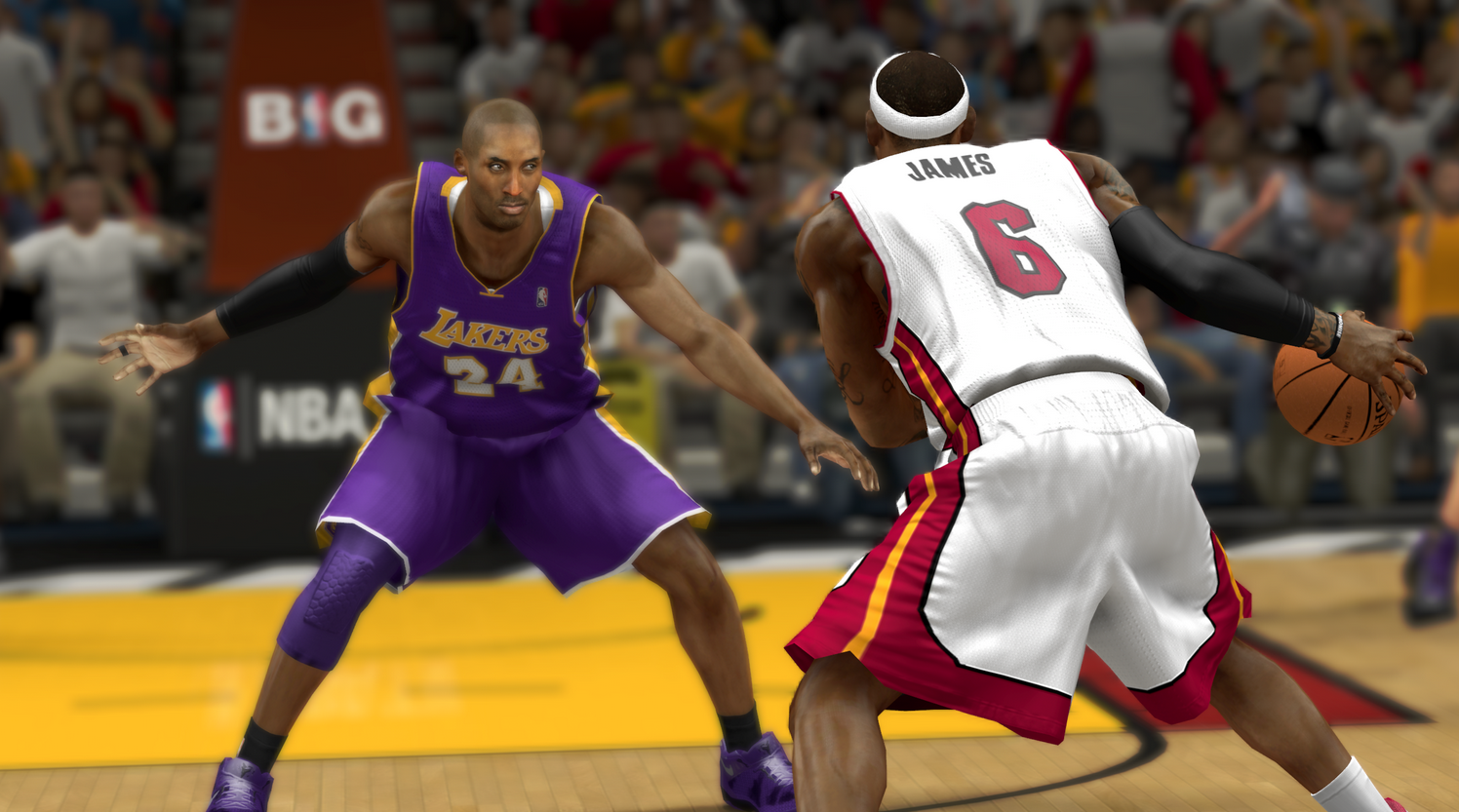
If you played NBA 2K13, you know just how frustrating the defensive AI could be. Your teammates often played so foolishly that it was difficult to feel like you weren't alone on the court trying to defend against the opposing team.
Thankfully, developer Visual Concepts has significantly improved the player AI this time around. Players on the defensive will follow other players and interpret when an opponent is attempting a screen pass. They'll even jump to intercept passes or block shots at the right time, rather than a half-second later.
While I'd like to thing that Visual Concepts beefed up the defensive players just because it was the right thing to do, I think it probably has something to do with the new Assist Pass feature. Instead of just hammering the A button to pass to a player, holding Left Trigger (on Xbox 360) and pushing the stick in a direction will throw an assist pass their way, which is either a no-look pass or something one-handed. It looks extremely cool and can lead to some off-the-wall plays when it actually works; unfortunately, it ends in spectacular failure more often than not.
Even so, the addition of the assist pass and beefed-up defensive AI creates opportunities for high-level play that just didn't exist in previous 2K NBA games.
Unfortunately, the AI isn't always that dreamy. In fact, most of the time it's still astoundingly stupid; I lost count how many times the ball was turned over because of errors made by the AI-controlled players that had nothing to do with me.
It isn't just small stuff either; players are constantly running out of bounds with the ball, missing offensive rebounds simply because they don't move toward the hoop when the ball is shot, and incorrectly following plays called directly by the player.
It's inexcusable that your AI opponents can sink nearly every shot they take, yet friendly AI-controlled players can't help but get called for goaltending on the rare occasion that they happen to miss. Visual Concepts has done a decent job of adequately modeling the behavior of real human beings on a ball court, but these frustrating behavioral errors are proof that there's work to be done on improving the player AI to be believable and consistent.

One of NBA 2K14's most advertised features is the new LeBron: Path to Greatness mode, which replaces last year's focus on Michael Jordan and his historic career in the NBA. Instead of focusing on the past, Path to Greatness is all about playing through LeBron's hypothetical future.
You're given two options: stick with the Heat for a dynasty or move on to try your luck on other teams through the league. It's a really unique take on the player-specific modes that have become popular additions to sports games in recent years. Best of all, it comes off feeling a bit like some version of fantasy basketball as you control LeBron's career, making moves game after game.
Since it's all hypothetical future match-ups, you're never reliving some prime-time moment; you have to create those moments for yourself as you play through LeBron's games. It can be difficult, too, as these are undoubtedly some of the most challenging games I found in 2K14. These match-ups are often brutal, and they really highlight where the AI inconsistencies lie.
If you're a fan of 2K's past games and don't want to wait for next-gen options, picking up NBA 2K14 is a foregone conclusion. You simply don't have any alternatives, and the game itself feels authentic and well-crafted, even in the absence of many readily-visible graphical enhancements. If you aren't in a rush for another NBA game, it might be worth waiting to see what EA has in store for next-generation basketball and how that affects NBA 2K14 on the Xbox One and PlayStation 4.

Alex is a freelance videogame writer who writers for PCWorld's GameOn. He likes Star Wars a lot, maybe a bit much.
More by Alex Rubens
 No one can deny Netflix is betting big on its original content -- and for very good reasons, mind you. In light of this, the video streaming giant is already preparing to premiere yet another series of its own: a psychological thriller from the brains behind the television show Damages. Netflix ...
Break out the champagne! Rose McGowan and Davey Detail tied the knot during an intimate outdoor ceremony at the Paramour Mansion in Silverlake on Saturday, Oct. 12, her rep confirms to Us Weekly.
PHOTOS: Celebrity weddings 2013
McGowan, 39, wore a strapless white dress and a veil for her special day, with her hair up in a bun. She also carried a bouquet of pink flowers down the aisle. The couple's vows lasted 15 minutes. A New Orleans swing band then played as guests were escorted to a cocktail area with stunning white lights surrounding a courtyard.
The Tell-Tale Heart star and Detail first announced their engagement in July after more than a year of dating, with the actress previously telling Us that she thought her artist beau was "magic."
PHOTOS: Other stunning celebrity weddings
"He's made me a better woman. And I've made him a better man!" she shared with Us at the premiere of Mademoiselle C in NYC on Sept. 6.
The actress was previously twice-engaged -- to Machete Kills director Robert Rodriguez in 2007 and before that, to rocker Marilyn Manson in 1998 -- but this is her first marriage.
Next up? The happy newlyweds are heading to Tahiti for their honeymoon, according to McGowan. "I've never been," she previously told Us. "I've always dreamed of having one of those little huts over the water."
Clams are her favorite thiiiiiiiiiing!
Clams are her favorite thiiiiiiiiiing!
It's an old, hardy comedy trope: A black person has to turn up the volume on some stereotypical behavior in order to navigate some social situation. The sketch is a self-aware take on a modern reality. Even after the era of minstrel shows ended and black actors stopped living out egregious stereotypes for white audiences, white folks still ran mainstream showbiz. If you were going to be black onstage or on camera, your image was still controlled by a largely white industry.
That's still the case, and there's a whole thread of comedy that goes to that well, poking fun at black actors being instructed "to act blacker" (whatever the hell that even means). Let's call them "Black It Up" routines. The most famous one is probably Robert Townsend's bit from Hollywood Shuffle, in which he imagines an acting school designed to prep aspiring black actors on how to land the roles most available to them. Here it is, if you haven't seen it (heads-up: salty language):
What makes this routine so biting is the acknowledgment that the economic calculus dictates that this must be so. Yes, this role is demeaning and the insult is exacerbated by white folks telling me I'm not doing it right — but I also gotta eat.
Townsend's entire movie is about the indignities visited upon black actors trying to earn a living. It may seem a little too on the nose today — the number for the black acting school is "1-800-555-COON" — but the sketch was influential. And it's still pretty funny. (The tall white guy teaching those dudes how to walk at 4:21 is gold. Why is he doing that thing with his neck? Why are his arms swinging so much?)
This Shuffle bit is the obvious spiritual ancestor to this Sprite commercial that people of my generation will remember in which a bunch of tough-talking street ball players begin speaking in exaggerated British accents as soon as the director yells cut. Don't talk to me like a child! I played Hamlet at Cambridge!
Earlier this year, the Upright Citizens Brigade comedy troupe revisited this same idea, and they cut out a lot of the fat in the process. A quarter-century passed between the Townsend sketch and the UCB sketch, and their approaches say volumes about the way the media landscape has and hasn't changed.
Townsend's acting school is selling the chance to be a pimp or a slave; the condescending casting agent in the later UCB sketch rattles off a bunch of Hollywood household names — Oprah, Tyler Perry, Spike Lee — as touchstones for the kind of blackness she's trying to elicit from the eager actress. Progress! One of the good jokes in the bit is that Oprah, Perry and Lee don't all share a sensibility, but the casting director collapses them all into one idea: They're all black people, and so thus interchangeable!
It's not hard to imagine a version of this skit in which the actress, played by Nicole Byers, is resistant to the casting agent's directions. ("You want me to what?") But what makes this one so hilarious as that she's buying all the way in. And the more outlandish her performance is, the more ridiculous the directions she's getting seem. By the end, the eager actress is a munificent, bellowing, body-rolling dispenser of clams — who also doesn't even begin to resemble a real person. (What confluence of stuff has led to this moment in which Shawanna has to go fetch this person some clams? I want to see this play/movie! It sounds terrible!)
This skit seemed to resonate for real actors of color, too. "I've def been in this audition," one commenter said. "She is not exaggerating what it's like going to casting calls as a Black, Hispanic or Asian actor!" said another.
It's hard to knock the hustle, though; folks gotta eat.
Last year, the great Yvette Nicole Brown of NBC's cult favorite Community, talked about this nudging from directors, who try to get euphemistic with it in real life — could you be more sassy?
Female friends that are in my tribe, black girls, we all have stories about that. We find interesting ways to make [directors] tell us to be sassy because they know that it's racist. I say, "Can you show me how to do that?" They don't want to do a black version of sassy, so then they move on.
Community went to this well, too, by having Dean Pelton (played by Jim Rash) try to get Shirley (Brown's character) to be more sassy for a commercial. But Pelton can't bring himself to say the s-word. ("What's another word for 'happy-threatening'?" he asks his assistant, Annie.)
Now look at this Key & Peele sketch, also from this year, which takes this same idea about racial performance and flips it yet again.
The awkwardness of wearing different public faces is a central part of Key & Peele's comedy — see the duo's famous "Phone Call" sketch or their hilarious "I Said Bitch" sketch. (I'm also required by law to make the obvious reading in which Key & Peele's biracial-ness probably informs their obsession with the Janus-like.)
In "Black Jeff / White Jeff," Key's lady friend wonders why he doesn't push back harder at the waitstaff at the restaurant where they're having dinner. He tries to switch it up, but doesn't know how to modulate — code-switching gone horribly awry! — and ends up directing his opprobrium and his flattery at the wrong folks. Keegan Michael Key's gift for physical comedy gives the sketch its energy; he flips between stereotypes of blackness, whiteness and even Latino-ness at one point, ultimately all for naught. But he's not playing an actor here, he's just a regular guy who is literally just trying to eat. (I'm going to call shenanigans on this: His girlfriend seriously thought "blacking it up" was going to get them better service? Ma'am.)
It's worth noting that this "be more [euphemism for your race]" isn't limited to Blacking It Up, specifically; Latina actresses are almost certainly told to "be more spicy."
The natural next step in the evolution of this idea, of course, is the "Be Whiter" sketch. Maybe some super-down white college kid who grew up with black folks and runs her campus chapter of the NAACP has to learn to reverse-code switch or something. (Could we try this, but maybe a little more "mainstream"? A little less FUBU* and a little more J. Crew?)
So Code Switch readers: What's your favorite sketch with this idea and why? What versions would you most like to see? (If you refer to a video, try to share a link in the comments.)
* Don't nobody wear FUBU anymore. If you know otherwise, pics or it didn't happen.